Showing posts with label Chesapeake Bay. Show all posts

Thursday, April 2, 2015

Maryland Weekly Fishing Report Overview | April 01, 2015


Maryland Weekly Fishing Report Overview | April 01, 2015 


It certainly was a cold opening day for trout fishermen this past Saturday and one that will be talked about for many years. One can imagine many of our young anglers 20 or 30 years from now relating to their children. "When I was your age it was so cold on opening day that my fishing rod guides froze with ice". The weather service tells us that so far this is the coldest spring on record in Maryland. Warmer weather is in the forecast and continued trout stockings will make for good fishing this week and for weeks to come. Neil Villanueva and Brandon Collins braved cold fingers and toes on opening day but proudly hold up their reward.

Photo Courtesy of Neil Villanueva
The big story for anyone watching for the window of opportunity to be able to fish the anticipated spawning runs of white perch, is the fluctuating water temperatures. Water temperatures in the tidal rivers recently took a nose dive due to chilly weather and the tidal rivers and are barely holding at 50ºF today. Warmer weather is in the forecast for the rest of the week and a few sunny days will help a lot. Water temperatures at the mouth of the Susquehanna are a finger numbing 40ºF. A few folks have been out trying some catch and release fishing for striped bass around the flats but there have been no takers and the large females might not even be there yet since the bay water temperatures are not much warmer. There are some yellow perch being caught in the deeper waters of the lower Susquehanna River and a little bit of action in the Northeast River. Other tidal rivers in the upper bay such as the Sassafras and Chester can provide some good fishing action for post spawn yellow perch in the upper sections and the vanguard of the white perch spawning run may also be experienced.
Farther down the bay; the Calvert Cliffs Power Plant warm water discharge seems to be the only show in town when it comes to catch and release action for striped bass. Bouncing soft plastic jigs or metal in the wash of the discharge in a drifting boat has been providing some rod bending catch and release action.
Since fall/winter 2014, Fisheries Service has been taking steps to assure recreational anglers are aware of recreational and commercial striped bass fishery management rule changes necessary to comply with the Atlantic States Marine Fisheries Commission's (ASMFC) approval of Addendum IV to the Interstate Striped Bass Fishery Management Plan. Addendum IV required a 25% reduction in the coastal fisheries and a 20.5% reduction in the Chesapeake Bay fisheries.
After public input and lengthy discussions with the Sport Fisheries Advisory Commission (SFAC) of several different options to achieve the mandated reduction, the Department proposed the option which best meets the diversity of interests among Maryland's anglers. It continues to provide an opportunity for a trophy fish (>40") while also providing an opportunity to those which would like to have a better chance to bring a fish home. It also provides increased protection to the female spawning stock which is an objective of ASMFC's recent management action. In mid-March we learned that the ASMFC Striped Bass Technical Committee had approved Maryland's proposal. Therefore, regulations for this year are as follows:
A person may only take or possess:
  • One striped bass between 28 inches and 36 inches or one striped bass larger than 40 inches from April 18, 2015 to May 15, 2015.
  • Two striped bass larger than 20 inches, only one of which may be larger than 28 inches, from May 16, 2015 to December 15, 2015.
EXCEPTION: A person may only keep one striped bass between 20 inches and 26 inches in the Susquehanna Flats and the Northeast River, as described in COMAR 08.02.15.09A(3), from May 16, 2015 through May 31, 2015.
Maryland has submitted an appeal to the ASMFC concerning the 20" minimum for striped bass in Maryland's portion of the Chesapeake Bay.
There are white perch staged in just about every tidal river in the middle and lower regions of the bay. Cold water temperatures have most of the white perch holding in deeper water a few miles downriver from the spawning areas. Fisheries biologist Butch Webb has been monitoring the white perch spawning run in the Choptank River recently and offered us these observations. We are seeing a lot of smaller white perch this year. There hasn't been a run of big perch to this point and they are starting to spawn so we may not get a run of good ones further up the river. The water temps have been variable from 47º to 50º depending on night time air temperature. We have caught at least one blue catfish a day for the past four days.
Although rain is predicted towards the end of the week; warm air temperatures and plenty of sun penetration into the waters of the tidal rivers should spur the white perch runs this coming weekend which will fit nicely into folk's schedules. Small shad darts tipped with a piece of minnow or other favorite baits will be a good choice for weeding through the surge of small white perch in the upper reaches of the tidal rivers. The throwback ratio is usually high on spawning white perch runs so lures such as shad darts get you back into the action faster than the classic grass shrimp bait under a bobber.
There seems to be a bit of a shortage in the bloodworm market so far this season. Cold temperatures and heavy snow in Maine have made it difficult for diggers to supply enough bloodworms to go around. Apparently European buyers are also purchasing as many bloodworms as they can for their fishermen. Hopefully the market will ease up as we get farther along into spring.
Trout fishing is now shifting gears as anglers begin to find more elbow room at trout management waters and additional trout stockings at numerous locations. In season trout stocking will continue into May. Anticipated stockings can be found on the trout stocking schedule link; anglers are reminded that the date listed means "the week of". Completed stockings can also be observed on the trout stocking website.
An ultra light spinning outfit, some hooks, a few split shot and some Powerbait are the basics for trout fishing in the put and take areas. Something to put your trout in is a handy thing to have and a landing net can be a very valuable tool to have especially if you happen to run into one of the trophy sized trout that are stocked at every location. There was a funny video several years ago of an angler jumping into the Patapsco to bear hug his trophy trout because he did not have a landing net. Ronny Rice looks happy and dry in this photo of the largest trout he has ever caught; Ronny was fishing on the Gunpowder this past Monday.
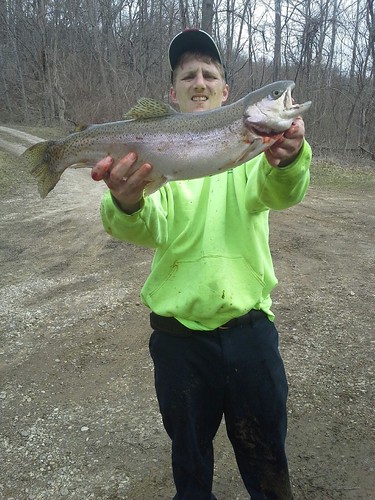
Photo Courtesy of Ronny Rice
There are many ponds near populated areas that are stocked with trout which make them ideal for taking young anglers, some are even set aside just for young anglers so be sure to check out the trout stocking website and the trout stocking maps site can also be very helpful.
Fisheries biologist John Mullican sent us a wonderful report from the upper Potomac River. The upper Potomac River is in great shape with slightly below average flow. Temperatures are now in the mid-40s and climbing. Smallmouth bass are becoming more active and fishermen are catching quality-size bass on tubes, hair jigs, and suspending jerkbaits.
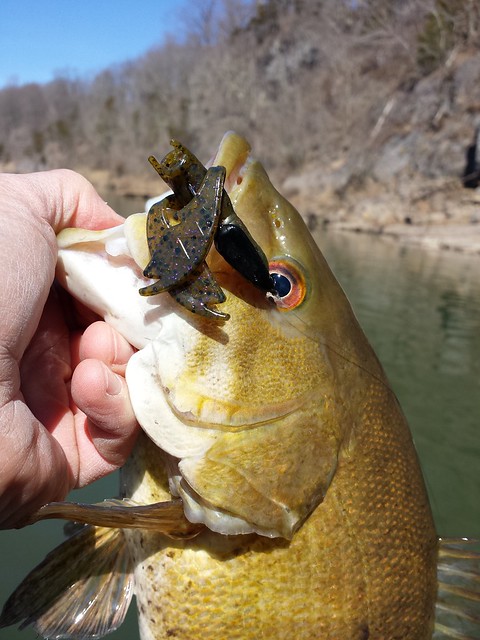
Photo by John Mullican
Walleye have begun spawning and consequently the fishing has been slow. However, once the spawn is complete, walleye will resume feeding and the fishing should improve. After completing their spawning activities, walleye will spread out throughout the river. This is a good time to throw jerkbaits and crankbaits to cover water more efficiently and find fish. A lightweight jig and grub combo presented slowly near the bottom will be more effective when the fish are not as active.
Inland Fisheries staff recently collected brood walleye for the Manning Warmwater Hatchery in Cedarville. Ice and high water resulted in a very small window of opportunity to conduct the collection. Unfortunately for fishermen, the pre-spawn walleye fishing was reduced to only a week or two before spawning began. The fingerlings produced from the Potomac River walleye are used to supplement existing natural reproduction in the river as well as supply fingerlings for stocking throughout Maryland. Several large muskie were captured during the survey as well.
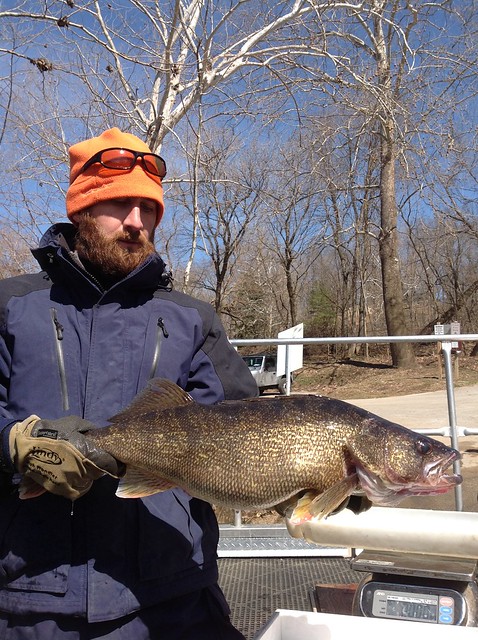
Photo by John Mullican
Maryland's many small ponds and impoundments are beginning to warm up as sunny days prevail and night time air temperatures are becoming more moderate. Largemouth bass, bluegills and crappie are beginning to stir and can be found in the deeper areas of transition zones leading from the deepest waters to shallower areas. Sunny afternoons can be a good time to fish as species such as largemouth bass respond favorably to the warming sun. Soft plastics worked slowly and close to the bottom in these areas is a very good tactic. Crappie and bluegills can be caught under slip bobbers rigged with a small jig or bait about 3' to 5' under the bobber. Crappie tend to be found near deep structure right now, such as bridge piers, fallen tree tops or sunken wood.
More and more open water is being seen at Deep Creek Lake this week; most of the coves are open and the state boat ramp is open. The shorelines of the main lake are open but main lake ice still prevails. Winter is always a little less than ready to give up its grip on the western most sections of Maryland and Deep Creek Lake is no exception.
The parking lots and every other available space in the Ocean City area tends to be full of boats up on chocks, but more and more activity can be seen as owners and crew prepare boats for the upcoming season. A few boats have been venturing offshore though in search of tautog at some of the wreck sites farther offshore. Boats have also been traveling out to the canyons for deep drop fishing and one boat while trolling in the Baltimore Canyon area recently caught a small mako shark.

Saturday, February 21, 2015

Maryland Rally for Clean Water

Maryland Rally for Clean WaterRegister Now

Welcome to the "Don't Backtrack on the Bay!" Rally for Clean Water!
We're excited to see you on Lawyer's Mall in Annapolis on February 24. Please register to let us know you're coming!
We will be at Lawyer's Mall with t-shirts, a photo booth, snacks, and poster-making supplies starting at 11:30 a.m.
Please arrive no later than 11:45 a.m. to get a t-shirt, take a photo in our photo booth, and make a poster. A brief program featuring Maryland legislative leaders for clean water will start at 12 noon.
Some helpful tips for a fun rally:
  • Dress for success! Wear lots of blue, and arrive early to get a t-shirt. Also, dress appropriately for the weather.
  • Bring a homemade sign that reflects why you care about clean water, or arrive early to make one at the rally
  • Bring a photo ID so that you can deliver a message to your legislator or attend a hearing later that day. You will need it to get through security in the legislative office buildings to deliver messages to your senator or delegate.
What else is happening that day? At 1:00 pm, a hearing will be held in the Senate Education, Health, and Environmental Affairs Committee on legislation introduced by Senator Paul Pinsky to reduce pollution from agricultural sources. If you are interested in seeing the Maryland General Assembly at work and showing your support for clean water, consider attending the hearing.
Parking and public transportation: Locations for public parking around the State House can be found on this map. You can also park at the Navy Stadium outside of downtown for $5 and take the Navy Blue or State shuttle to the State House for $2. The shuttle runs on a 20-minute interval, so be sure to allow enough time for travel. Further information is available here. Annapolis runs a free Circulator Trolleybetween select downtown locations on a 20-minute interval as well.
If you are coming to the rally from the Eastern Shore, we are arranging bus transportation for those interested. Please register as soon as possible if you would like a ride to the rally.
Eastern Shore bus itinerary:
10:15 a.m.Depart Easton Walmart
8155 Elliott Road
Easton, MD 21601
10:45 a.m.Pickup additional passengers at
Nike Factory Store
441 Outlet Center Drive
Queenstown, MD 21658
10:55 a.m.Depart Nike Factory Store
11:30 a.m.Drop off passengers at Lawyer's Mall, State House, Annapolis, Maryland
2:00 p.m.Pick up passengers at Lawyer's Mall, State House, Annapolis, Maryland
2:30 p.m.Drop off passengers at
Nike Factory Store
441 Outlet Center Drive
Queenstown, MD 21658
3:15 p.m.Drop off remaining passengers at
Easton Walmart
8155 Elliott Road
Easton, MD 21601

Thursday, June 27, 2013

Fireworks Schedule Around the Bay

Mariners are advised that, as described in Title 33 Code of Federal Regulations Section 100.506, the following safety zones are established for fireworks displays planned during the 2013 Independence Day holiday period:
1. Anacostia River, Washington, DC, within a 200-yard radius of the fireworks barge in approximate position 38°52′16″ N,
077°00′13″ W, located approximately 500 yards southeast of the shoreline near Washington Nationals Ball Park. This safety
zone will be enforced on July 3, 2013, from 7:30 p.m. to 11 p.m. (no rain date) for a fireworks display scheduled for
approximately 9:30 p.m. Chart 12289.

2. Baltimore Inner Harbor, Patapsco River, Maryland, within a 150-yard radius of the fireworks barge in approximate position 39°16′55″ N, 076°36′17″ W, at the entrance to Baltimore Inner Harbor, approximately 150 yards southwest of Pier 6, and
Northwest Harbor (Western Section), Patapsco River, Maryland, within a 250-yard radius of the fireworks barge in approximate position 39°16′37″ N, 076°35′54″ W, located near the western end of Northwest Harbor. These safety zones will be enforced on
July 4, 2013, from 8 p.m. to 10:30 p.m. (with a rain date of July 5, 2013) for a fireworks display scheduled from 9:30 p.m. to 10 p.m. Chart 12281.

3. Chesapeake Bay, Chesapeake Beach, Maryland, within a 150-yard radius of the two fireworks barges in approximate position 38°41′36″ N, 076°31′30″ W and 38°41′28″ N, 076°31′29″ W, located north and south of the jetties at Chesapeake Beach, Maryland. This safety zone will be enforced on July 3, 2013, from 8:30 p.m. to 10:30 p.m. (with a rain date of July 5, 2013) for a fireworks display scheduled from 9:15 p.m. to 9:45 p.m. Chart 12263.

4. Choptank River, Cambridge, Maryland, within a 300-yard radius of the fireworks launch site located at Great Marsh Point, Cambridge at 38°35′06″ N, 076°04′46″ W. This safety zone will be enforced on July 4, 2013 from 8 p.m. to 10:30 p.m. (with a rain date of July 5, 2013) for a fireworks display scheduled for 9 p.m. Chart 12266.

5. Middle River, Baltimore County, Maryland, within a 300-yard radius of the fireworks barge in approximate position 39°17′45″ N, 076°23′49″ W, approximately 300 yards east of Rockaway Beach, near Turkey Point. This safety zone will be enforced on July 6, 2013, from 8 p.m. to 10:30 p.m. (no rain date) for a fireworks display scheduled for 9:30 p.m. Chart 12278.

6. Northeast River North East, Maryland, within a 300-yard radius of the fireworks barge in approximate position 39°35'26'' N, 075°57'00'' W, located approximately 400 yards south of the North East Community Park. This safety zone will be enforced on July 3, 2013, from 8 p.m. to 10:30 p.m. (no rain date) for a fireworks display scheduled for 9:15 p.m. Chart 12274.

7. Patuxent River, Solomons Island, Maryland, within a 300-yard radius of the fireworks barge in an area bound by the following points: 38°19′42″ N, 076°28′02″ W; thence to 38°19′26″ N, 076°28′18″ W; thence to 38°18′48″ N, 076°27′42″ W; thence to 38°19′06″ N 076°27′25″ W, thence to the point of origin, located near Solomons Island, MD. This safety zone will be enforced
on July 4, 2013, from 8 p.m. to 10 p.m. (with a rain date of July 5, 2013) for a fireworks display scheduled for 9:15

8. p.m. Chart 12284.

9. Potomac River, Prince William County, Virginia, within a 200-yard radius of the fireworks barge in approximate position 38°34′08″ N, 077°15′34″ W, located near Cherry Hill, Virginia. This safety zone will be enforced on June 29, 2013, from 8 p.m. to 10:30 p.m. (with a rain date of June 30, 2013) for a fireworks display scheduled for 9:30 p.m. Chart 12289.

10. Severn River and Spa Creek, within an area bounded by a line drawn from 38°58′39.6″ N, 076°28′49″ W, thence to 38°58′41″ N, 076°28′14″ W, thence to 38°59′01″ N, 076°28′37″ W, thence to 38°58′57″ N, 076°28′40″ W, located near the entrance to Spa Creek in Annapolis, Maryland. This safety zone will be enforced on July 4, 2013, from 8 p.m. to 10:30 p.m. (with a rain date of July 5, 2013) for a fireworks display scheduled from 9 p.m. to 9:30 p.m. Charts 12282, 12283.

11. Tred Avon River, Oxford, Maryland, within a 150-yard radius of the fireworks barge in approximate position 38°41′24″ N, 076°10′37″ W, approximately 500 yards northwest of the waterfront at Oxford. This safety zone will be enforced on July 3, 2013from 8 p.m. to 10:30 p.m. (with a rain date of July 5, 2013) for a fireworks display scheduled from 9:30 p.m. to 10 p.m. Chart 12266.

12. Upper Potomac River, Alexandria Channel, within a 300-yard radius of the fireworks barge in approximate position 38°48′37″ N, 077°02′02″ W, located near the waterfront of Alexandria, Virginia. This safety zone will be enforced on July 13, 2013, from 7:30 p.m. to 11 p.m. (with a rain date of July 14, 2013) for a fireworks display scheduled for 9:30 p.m. Chart 12289. Fireworks barges and launch sites on land will have signs labeled FIREWORKS--DANGER--STAY AWAY to provide on scene notice that the safety zone will be enforced. Vessels may not enter, remain in, or transit through the safety zone during the
enforcement period unless authorized by the Coast Guard Captain of the Port (COTP) or designated Coast Guard patrol personnel on scene. All persons and vessels shall comply with the instructions of the COTP or the designated on-scene-patrol personnel, and upon being hailed by siren, radio, flashing light or other means, the operator of a vessel shall proceed as
directed. Other Federal, State and local agencies may assist these personnel in the enforcement of the safety zone. For any comments or questions, contact Coast Guard Sector Baltimore Waterways Management Division, at (410) 576-2674, (410) 576-2693 or Ronald.L.Houck@uscg.mil.

13. Aquia Creek, Stafford, Virginia, mariners are urged to remain at least 200 yards from the fireworks discharge barge located in Aquia Harbour on July 4, 2013 (no rain date) for a display scheduled from 9:20 p.m. to 10 p.m. Chart 12288.

14. Chester River, Town of Chestertown, Maryland, mariners are urged to remain at least 200 yards from the fireworks discharge site located on shore near the mouth of Radcliffe Creek on July 4, 2013 (no rain date) for a display scheduled from 9:20 p.m. to 10 p.m. Chart 12272.

15. Fairlee Creek, Great Oak Landing Marina, Maryland, mariners are urged to remain at least 200 yards from the fireworks discharge site located on shore at Shell Point on July 6, 2013 (rain date of August 31, 2013) for a display scheduled at 9:25 p.m. Chart 12274.

16. Herring Bay, Herrington Harbour South Marina, Rose Haven, Maryland, mariners are urged to remain at least 150 yards from the fireworks discharge site located on the south jetty on July 3, 2013 (rain date of July 4, 2013) for a display scheduled at 9:30 p.m. Chart 12266.

17. Miles River, St. Michaels, Maryland, mariners are urged to remain at least within a 200-yard radius of the fireworks discharge site located on a point of land at the mouth of Long Haul Creek on July 6, 2013 (rain date of July 7, 2013) for a fireworks display scheduled for 9:30 p.m. Chart 12263.
18. Nanticoke River, Nanticoke, Maryland, mariners are urged to remain at least 70 yards from the fireworks discharge site located on the end of a pier at the Jay Pepper Campground on July 5, 2013 (rain date of July 6, 2013) for a fireworks display scheduled for 9 p.m. Chart 12261.

19. Patuxent River, Golden Beach/Patuxent Knolls Civic Association, Maryland, mariners are urged to remain at least 200 yards from the fireworks discharge site located on shore near Long Point on June 29, 2013 (rain date of June 30, 2013) for a display scheduled at 9:30 p.m. Chart 12284.

20. Potomac River, Colonial Beach, Virginia, mariners are urged to remain at least 50 yards from the fireworks discharge site located on the shoreline near the entrance to Monroe Bay on June 29, 2013 (rain date of July 7, 2013) for a display scheduled
at approximately 9 p.m. Chart 12286.

21. Potomac River, Town of Colonial Beach, Virginia, mariners are urged to remain at least 150 yards from the fireworks discharge site located at the end of the Municipal Pier on July 4, 2013 (rain date of July 6, 2013) for a display scheduled at approximately 9 p.m. Chart 12286.

22. Rock Hall Harbor, Rock Hall, Maryland, mariners are urged to remain at least 150 yards from the fireworks discharge site located on shore on July 3, 2013 (rain date of July 4, 2013) for a display scheduled at 9 p.m. Chart 12278.

23. Severn River, Sherwood Forest, Maryland, mariners are urged to remain at least 150 yards from the fireworks discharge site located at the end of the Sherwood Forest Club’s Main Pier on July 3, 2013 (rain date of July 6, 2013) for a display scheduled at 9 p.m. Chart 12282.

24. St. Mary’s River, St. Mary’s City, Maryland, mariners are urged to remain at least 150 yards from the fireworks discharge site located at the end of a dock at St. Mary’s College of Maryland on July 5 2013 (no rain date) for a display scheduled at 9 p.m. Chart 12233.

25. Susquehanna River, Havre de Grace, Maryland, mariners are urged to remain at least 300 yards from the fireworks discharge site located on shore at Park Island on July 6, 2013 (no rain date) for a display scheduled at 9:30 p.m. Chart 12274

Mariners are urged to transit these areas with caution, to keep a sharp lookout for other watercraft in these areas, and are reminded to heed the directions of patrolling law enforcement and public safety officials. Absent specific guidance, mariners should remain 300 yards from any fireworks discharge site. For any comments or questions, contact Coast Guard Sector Baltimore Waterways Management Division at telephone number (410) 576-2674, (410) 576-2693 or email
Ronald.L.Houck@uscg.mil.

Sunday, July 1, 2012

Maryland DNR Reminds Boaters and Swimmers of Safe Practices for Independence Day

     Annapolis, Md. -- With the Fourth of July nearing, the Maryland Department of Natural Resources (DNR) and the Natural Resources Police (NRP) are urging citizens and visitors to be extra vigilant in and on the water for the holiday and throughout the summer.
    “We want everyone to be able to enjoy the wonderful recreational opportunities our State has to offer, on water and land, to the fullest,” said Superintendent Colonel George F. Johnson IV. “But the importance of safety while boating and swimming cannot be overstated and must be a number one priority while enjoying Maryland waterways and State Parks.”
     Last year, Maryland experienced an unusually high number of boating deaths. Over the summer, NRP will focus their enforcement efforts on those activities that contribute to boating accidents, such as alcohol, negligent operation, bow riding and navigational violations.
     NRP recommends that swimmers stay within designated swimming areas with lifeguards on duty whenever possible. Lifeguards keep all swimmers informed of any changes in water conditions and are trained to respond if an emergency occurs.
     NRP also offers the following swimming safety tips:
When swimming outside guarded areas, obey all warning signs that alert swimmers to dangers and be aware of any surrounding signs or markers that indicate current water conditions.
Never swim alone or while under the influence of alcohol or drugs.
Pay special attention to small children and use safety devices such as life jackets on children or other individuals who cannot swim.
Carry a cell phone or have other ways of contacting emergency personnel if a situation arises.
      If an emergency occurs, immediately call 911 and remember to Reach, Throw, Row and Go:
REACH the person in trouble by extending a releasable item, such as a pole, line or rope to pull them to safety ─ but not by hand, as the rescuer could quickly become another victim.
THROW an object that floats to the victim if they are unreachable. Life rings, PFDs, coolers or plastic jugs are suitable floating objects that can keep a troubled swimmer afloat until rescuers arrive.
ROW to the victim using a canoe or any other safe watercraft. The rescuer must wear a life jacket. Once the victim is nearby, a rope or paddle should be extended and used to tow the victim to shore if possible.
GO to the victim by entering the water as a last resort and ONLY if properly trained. The rescuer should bring an object to keep the victim afloat and to prevent being pulled under.
     More information on boating safety is available at dnr.maryland.gov/boating/safety.

Friday, June 29, 2012

Keith Lockwood's Maryland Fishing Report

     Oxford, Md. -- As we bid farewell to June and get ready for the 4th of July that just so happens to fall in the middle of the week this year; summer time fishing is in place. Many of our summer visitors are now here in the Chesapeake Bay and ocean waters and beckoning to fishermen to come out and try their luck and the quiet lakes, ponds and waterways offer a retreat from the more hectic life for freshwater fishermen to try their luck.
      On Thursday, biologists and young anglers were out on the waters of the Chesapeake tagging and releasing striped bass in portions of the bay from the upper bay to the lower bay for the July portion of the Diamond Jim series. These specially tagged striped bass can be worth up to $25,000 to a lucky fisherman.

Chesapeake Bay
     In the far upper reaches of the Chesapeake fishermen are finding good fishing for white perch and channel catfish in the channels of the Susquehanna and Elk Rivers. At the Conowingo Dam pool, fishermen are catching a mix of striped bass channel catfish and flathead catfish. The dam is generally on an afternoon power generation schedule.
     Fishermen are finding good striped bass fishing above the bay bridge at traditional locations such as Love Point, Swan Point and the eastern side of the shipping channel. Fishermen are chumming and finding the larger fish close to the bottom. Those fishermen that are trolling are using medium sized bucktails and swim shads along channel edges. Fishing around the bay bridge piers has picked up recently and fishermen are reporting catching striped bass by jigging over suspended fish or by live lining spot.
     Below the bay bridge in the middle bay region fishermen are finding striped bass along the eastern and western edges of the shipping channel and are trolling, jigging, chumming or live lining spot in a number of locations. A few of the traditional spots where the fishing has been good are Hackett's Bar, the Hill, Thomas Point, Tolley's Point, Breezy Point and the False Channel. Most fishermen that are trolling are using medium sized bucktails dressed with sassy shads either in tandem or behind umbrella rigs. Red surge tube lures, swim shads and Drone spoons are also popular choices for trolling. Fishermen are eager to begin live lining spot in earnest but are finding many of the spot they find available are as small as 2" in size. Using finer wire stock hooks can offer an advantage but use caution with dropping hook size if using J style hooks, to reduce deep hooking; using circle hooks will of course alleviate these problems. Shallow water fishing for striped bass in the early morning and late evening hours remains good this week.
     The bay and its tributaries seem to be flooded with a lot of small croakers this season and they have been found by fishermen as far as Denton on the Choptank River for example. It would seem that we are experiencing a strong year class perhaps and hopefully they will provide a boost to the croaker fishery in years to come. Although it might be tempting, fishermen should remember that the minimum size for croaker is 9" so small croaker can not be used for live lining. Croaker fishing has been fair at best in the middle bay area with good fishing in the evenings on a proper tide on shoal and channel edges. White perch have been filling in the gaps for fishermen in the tidal rivers and creeks whether they are bottom fishing with bait or casting small lures along shorelines in the early mornings and evenings.
     Lower bay region fishermen that are looking for striped bass have been spending a good deal of their time live lining spot at the 35' channel edge out in front of the Gas Docks at Cove Point. Although small, there are plenty of spot available in the region's tidal rivers and creeks. Trolling along the channel edges along the western side of the shipping channel and the lower Potomac remains good this week. Fishermen are seeing more bluefish now, so swim shads are being replaced with #1 and #2 Drone spoons. Chumming in the lower Potomac and areas such as Buoy 72 and the Rock Piles above Point Lookout are producing fair catches of striped bass and better catches of medium sized bluefish. Bluefish are also being found in good numbers around the Middle Grounds area.
     The shallow water fishing for speckled trout continues to be a very exciting fishing opportunity in the Tangier Sound area this week. Fishermen are using swim shads and topwater lures and also catching a mix of striped bass and bluefish.
     Croaker fishing remains good with the best fishing in the evenings on the proper tide along channel edges and shoal areas. Fishermen are finding peeler crab and shrimp baits have been working well. White perch, spot, bluefish, sub-legal red drum and the occasional flounder help round out the bottom fishing mix. Fishermen are reporting a lot of small red drum or puppy drum in the 12" size category all over the lower bay region in the shallows and deeper waters. One would sure hope they will return when they are in the 19" to 26" size class.

Crabbing
     Recreational crabbers report good crabbing this week in most tidal rivers and creeks below Kent Island. Reports from a few crabbers mention the crabbing dropping off in the creeks and backwaters of Kent Island and greatly improving in some western shore rivers such as the Severn. Generally crabbing remains steady with most recreational crabbers able to harvest a half bushel to a bushel of crabs per outing in the middle and lower bay regions and a couple of dozen crabs per outing in the upper bay.

Freshwater
     Freshwater fishermen are finding a variety of fishing opportunities across the state. Fishermen at Deep Creek Lake are finding a mix of yellow perch, bluegills, chain pickerel, northern pike, largemouth bass, smallmouth bass and walleye in varied locations at the lake. Drifting live minnows at various depths is a good tactic this time of the year, especially near deep grass.
     Largemouth bass tend to take center stage during the summer months for fishermen and the early morning and late evening hours are the best times to pursue them in shallow water areas. Casting topwater lures such as frogs are an exciting way to fish for largemouth bass; even if a strike doesn't result in a hook up. Spinnerbaits and chatterbaits retrieved over grass are good choices and seem to be a favorite of snakeheads in the tidal Potomac lately. As the sun rises higher in the sky and temperatures climb, dropping weedless soft plastics down through grass can entice strikes from bass hunkered down in the cool shade under the grass in deeper waters. The shade of old docks and fallen tree tops and the mouths of small creeks are also good places to look for bass trying to beat the heat.
     Fishing for bluegills is a favorite summer past time for many fishermen whether watching a bobber with a worm or cricket underneath or fishing with small lures. Perhaps one of the most exciting ways to catch bluegills is with a light fly rod, a floating line and some small rubber-legged poppers. Fishing for channel catfish remains very good this week in the upper Potomac, the Elk, Susquehanna, Choptank and numerous other rivers within Maryland.

At the Ocean
      Ocean City fishermen are seeing water temperature in the surf at around 74-degrees this week and are mostly fishing for a summer mix of seasonal fish. Using small baits they are catching a mix of kingfish, croaker, spot, flounder and small bluefish. Those wishing for a bit more pull are fishing late in the evening for large inshore sharks and sting rays.
     In and around the inlet fishermen are catching sheepshead, flounder, croaker and triggerfish during the day and striped bass and bluefish at night. Most of the striped bass being caught are less than 28" but some big ones are caught every night. Flounder fishing around the inlet and back bay areas has been very good when water clarity favorable. Larger flounder are being caught now that fishermen are beginning to live line spot.
     The boats venturing out to the wreck sites are coming back to the docks with good catches of sea bass; the throwback ratio is reported to be high but there are some whoppers out there.
     The boats heading out to the offshore waters are finding mostly yellowfin tuna and dolphin with a mix of bluefin tuna, white marlin, blue marlin and an occasional wahoo.

Wednesday, June 6, 2012

Keith Lockwood's Maryland Fishing Report

     Oxford, Md. -- Most everyone has been enjoying the cool weather that has recently moved in; warmer weather is on the way for the weekend and this is just such a great time to spend in the outdoors fishing with family and friends; not too hot but just right.
     There are plenty of kid's fishing derbies and such going on this time of the year and they present a wonderful opportunity to take kids fishing in a fun setting. If they don't already have a fishing outfit; let them pick out their own favorite theme related outfit; it tends to make it more personable for them and often these small closed face spinning outfits are just fine for bluegills. Keep an eye in your local newspaper for fishing derbies near you that are usually put on by service organizations. Be sure to check out the youth fishing website so your youngster can join and get a free patch.
     Fishermen who enjoy fishing at the base of the Conowingo Dam were happy to see June 1st arrive since now they can keep some of the fine striped bass they are catching. Casting swim shads and crankbaits has been a favorite tactic and if your bait gets close enough to the bottom there are big flathead catfish also looking for a meal. Farther down the Susquehanna some striped bass are being caught but the excellent white perch fishing tends to dominate the scene.
     Fishing for striped bass in the upper bay has been a trying affair for many fishermen lately with low dissolved oxygen levels lingering near the bottom in some areas due to algae bloom die offs in some of the major tributaries. Some fishermen have been having luck finding fish suspended in a zone above the poor oxygen levels and deep enough to stay cool. White perch and channel catfish can be found in many areas where good water flows occur such as around Hart-Miller Island and the mouth of the Magothy and Chester Rivers.
     In the middle bay region fishermen are finding suspended striped bass near steep points such as Thomas Point and traditional locations like Hackett's Bar and the western edge of the shipping channel. Many fishermen are jigging with soft plastics and others are trolling or chumming. Water temperatures in the mid bay area are running around 73-degrees on the surface and salinities up to 10 p.p.t.
     The shallow water fishery for striped bass is in full swing and fishermen who can get up early enough; which can be tough as sunrise is 5:40am, there is good fishing with topwater or swim shad lures. Wind of course has been a real hindrance since the cold front moved in and fishermen have found it hard to get out on the open waters of the larger tidal rivers or the bay. White perch can fill in the gap when turned back by whitecaps; so bring a smaller outfit and some beetle spin type lures, spinners or small swim shads and cast along likely looking leeward shorelines and take home some tasty white perch.
     In the southern region of Maryland's portion of the Chesapeake fishermen are finding excellent fishing for a mix of bottom fish such as croakers, white perch, spot and kingfish in the Tangier Sound area and a mix of striped bass, small bluefish and speckled trout along channel edges and shallows. The best catches of large croakers are occurring in the evening hours at shoal and channel edges. Croakers and spot are moving up most of the regions tidal river such as the Potomac and Patuxent and with the availability of spot, fishermen are beginning to live line spot near the Gas Docks with good success.
     Recreational crabbers are enjoying good crabbing in most of the tidal rivers south of Kent Island. Many crabbers are reporting large crabs and being able to catch a bushel per outing. The tidal creeks on the eastern side of the bay are being reported to be particularly good.

Freshwater
     Freshwater fishermen in the western region of the state are enjoying good water flows in most of the trout management waters and wonderful fly fishing opportunities. Walleye and smallmouth bass are entertaining fishermen at Deep Creek Lake along drop off edges and largemouth bass are holding outside of the cove areas near any kind of structure or grass.
     Largemouth bass fishermen are finding bass holding near grass and structure such as fallen tree tops and rocks. The large fish seem to be holding along channel edges and drop offs in deeper and cooler water. In some lakes that have been hit by heavy thunderstorms stained water can be an issue this week and the tidal rivers have been running high.
     Bluegills and other freshwater fish commonly called panfish can provide a lot of fun fishing this time of the year. Bluegills are either actively spawning or just finished in many areas of the state and can be caught in a variety of ways. Perhaps one of the simplest ways is a bobber and bait such as crickets or worms. Another method is to use a light weight fly rod and cast rubber-legged spiders and small poppers near the shallows.

At the Ocean
Ocean City fishermen report that the spring run of large striped bass along the beaches is starting to fall off. A few big fish are still being caught but inshore sharks such as sandbar, dusky, and sand tigers have become more common and are providing plenty of catch and release action. There are some smaller fish to be caught such as small bluefish, medium-sized black drum and a blowfish or flounder now and then.
     In and around the inlet fishermen are catching small bluefish and sub-legal striped bass and reporting fun catch and release action with hickory shad in the evenings. Flounder fishing inside the inlet and back bay areas has been good when water clarity conditions are favorable.
     Outside the inlet sea bass fishing on the wreck sites has been good and there is a lot of action but also a lot of throwbacks. Some captains report a better grade of sea bass and an occasional cod in deeper waters. The yellowfin tuna bite has turned on along the west wall of the Baltimore and Poorman's Canyons with some boats reporting double digit catches of good sized tuna. There is also a mix of dolphin, wahoo and a few white marlins in the mix. Mako sharks, threshers and blue sharks are also being caught along the 30-fathom curve at traditional locations such as the Hambone, Hot Dog and Sausages.

Saturday, June 2, 2012

Summer Sailing Courses Offered at the Chesapeake Bay Maritime Museum

     St. Michaels, Md. -- Kids can explore the Miles River and learn maritime skills in the Chesapeake Bay Maritime Museum’s (CBMM) summer sailing program, where new sailors and old salts gain the confidence to sail a small boat in a fun, safe, and encouraging environment.
     Weekly classes are available June 11 through August 3 for participants 8 years of age and older, and offer instruction for sailors at basic, intermediate and advanced sailing levels. The daily classes include limited classroom instruction and three hours of on-thewater experience.
     Participants learn sailing and teambuilding skills including water safety, rigging, boat handling and docking. The week ends with a family picnic and awards ceremony, where the students’ accomplishments are celebrated.
     Pre-registration is needed, with a museum member cost of  $200, or $225 for non-members.
     On the weekends, the museum also offers adult and teen basic sailing classes using the museum’s fleet of 15-foot boats. Hourly, private sailings lessons are also available by reservation.
     For class schedules, visit  www.cbmm.org/l_families.htm.
     Space is limited in all classes. To pre-register, contact Helen Van Fleet at 410-745-2916.

Wednesday, April 4, 2012

Keith Lockwood's Maryland Fishing Report

     Oxford, Md. -- The month of April is upon us and it would seem that temperatures are more within the norm now. Late February and last months warmer than normal temperatures had a profound effect on the traditional white and yellow perch spawns causing them to be earlier than normal. Fishermen have been expressing concerns that the same might also stand true for our spawning striped bass and a big question has been looming out there, like the elephant in the room sort of thing. Will there still be post-spawn striped bass around for the trophy season opener on April 21st?
     Although there was some spawning activity in late March; it was relatively minor and not at all out of the norm. There is usually a small spawn in late March according to striped bass experts. The water temperatures are certainly warm enough in most spawning reaches for spawning activity to take place but many of the striped bass have not arrived yet or if the females are there the eggs they are carrying are not mature enough to be released
     This past week the Susquehanna catch-release-area received an influx of male striped bass so the females will be arriving soon. In other spawning rivers such as the Choptank and Nanticoke Rivers which traditionally have an earlier spawn than the upper bay; the big female striped bass are spawning but only sparingly. Most of the spawning population of females are hunkered down waiting for the eggs they carry to mature enough to commence spawning. That traditionally should occur anywhere from this coming weekend to the end of the second week of April.
     Maryland DNR's Eyes on the Bay water quality website now has a mobile browser application. View the latest water temperature, salinity, and water quality measurements on your phone, from over 15 real-time tidal stations.
     Fishermen at the Susquehanna Flats area who have been putting in their time got a pleasant surprise this week as male striped bass moved into the region in force to provide nonstop action for those armed with soft plastic jigs and spoons. The males of most spawning species are the vanguards of the spawning run so larger female striped bass are anticipated to arrive soon. A few large fish are being reported by fishermen but most fish caught and released are falling in the 16" to 28" size range and are being caught tight to the bottom in water depths less than 15'.
     The hickory shad catch and release fishery in the Deer Creek area has kicked into gear with fishermen catching mostly male fish this week at the mouth of the creek and out in the Susquehanna River. Fisheries biologists were out on the Susquehanna recently electro-fishing for hickory shad brood stock and reported they found more American shad than hickories which is a very pleasant surprise. The adult American shad will be lifted over the dam in a mechanized fish lift so they may continue up the Susquehanna to spawn.
     Fishermen are practicing catch and release fishing for striped bass from prominent points and fishing piers all along the main stem of the bay; chunks of fresh menhaden or bloodworms have been the baits of choice on bottom rigs and circle hooks. A few fishermen have also been out on the bay trolling along the shipping channel edges practicing catch and release also. Water temperatures in the bay are holding around 53-degrees. All fishermen should remember that the spawning tidal rivers are off limits to any kind of catch and release fishing for striped bass until June 1.
     Freshwater fishermen who love their put and take trout fishermen were out in force on the traditional opening day and despite crowds most had a good time and caught trout. More than a few trout fishermen were surprised by a large bonus trout that were as large as 8 lbs on the end of their lines. The hatchery crews took the initiative to hold these trout and grow them up to exceptional sizes and give a thrill of a lifetime to lucky fishermen. Fishermen at Deep Creek Lake were happy to see the floating docks go in at the DNR boat ramps last week and many fishermen are enjoying the fishing action out on the lake for a mix of smallmouth bass, largemouth bass, walleye and a northern pike now and then. The fishing in the upper Potomac for smallmouth bass and walleye and muskies continues to be very good this week; water levels in the river are fine and of course the weather is gorgeous on most days.
     Largemouth bass fishermen are experiencing the best of the best this week as hungry pre-spawn largemouth bass are roaming the edges of emerging grass beds, sunken wood, rocky points and drop-offs for something to eat. Fishermen are finding excellent fishing opportunities in small farm ponds, lakes and tidal waters. A wide variety of lures from topwater lures to spinnerbaits, crankbaits, soft plastics and grub jigs are all working well; each in its own particular niche. Bluegills are offering plenty of sport this week and crappie fishing is always popular this time of the year.
     Ocean City fishermen continue to see tautog fishing inside the inlet improve as water temperatures hover at the 50-degree mark. All the traditional areas such as the south jetty, the 2nd to 4th street bulkhead, the ends of 5th and 6th streets and the Route 50 Bridge are all offering good fishing this week. Frozen sand fleas and pieces of green crabs are the preferred baits and the very beginning of an ebb tide seems to hold favor for many fishermen. Fishermen inside the inlet are also reporting catching and releasing a few flounder. Flounder season opens April 14th with a three flounder per day limit with a minimum of 17" each.
     Surf fishermen are catching some big striped bass, a few bluefish and plenty of dogfish and skates in the surf on menhaden baits. Offshore the boats taking fishermen out to the wreck sites are catching tautog and boats headed out to the canyon edges are finding tilefish and assorted deep water species.

Sunday, April 1, 2012

Sediment Temporarily Impacts Fishing Below Bloede Dam

     Ellicott City, Md. -- Since the removal of Simkins Dam, sediment has made its way down the Patapsco River and is now filling deeper holes and pools below Bloede Dam. The Department of Natural Resources (DNR) reminds recreational anglers that this is only temporary. The occurrence is an expected and natural process that was accounted for during initial planning.
     “Although disappointing to some anglers, the loss of these prime fishing spots is only temporary and was an expected outcome of the dam removal,” said Don Cosden, Assistant Director for Inland Fisheries. “The movement of coarse material and changes to the river landscape are part of the natural process.”
     The results of DNR Biological Stream Surveys confirm there are still fish to catch below Bloede Dam and as the material dissipates, the aquatic habitat will become cleaner and healthier throughout the Patapsco, creating a better fishing experience.
     The removal of Simkins Dam in December 2010 released large amounts of coarse sand and gravel that had collected behind the dam. Federal and State scientists mapped out the effects of the Simkins Dam project before it was removed using a sediment transport model. The model predicted that over time the sand and gravel would travel downstream temporarily filling pools, with the areas eventually returning to their natural state.
     “Storm events, not regular flow, have generally been the main force driving materials downstream,” said Mary Andrews, an engineer with the National Oceanic and Atmospheric Administration. “As the sediment moves, the depth of the river changes and the pools fill-in temporarily and later clear out. The area below Simkins Dam is recovering, no longer full of sand and gravel. We expect the same results for Bloede Dam as the sediment continues to move.”
     The timeline for when the area will to return to a more natural state depends on future high-flow events such as the occurrence, frequency and intensity of storms. In the mean time, hydrogeologists with McCormick Taylor, an engineering firm hired by the project partners continue to monitor movement both at regular intervals and in response to storms.
     Removal of the Simkins Dam is the culmination of more than two years of scientific study and engineering design that was vetted through the National Oceanic and Atmospheric Administration, as well as Maryland Department of the Environment, the U.S. Army Corps of Engineers and a number of local and national experts. This restoration project will allow fish access to new habitat and additional spawning ground, which has been shown to lead to healthier, more abundant fish stocks. Recreational users will also benefit from the elimination of this dangerous obstacle in the stream.
     The Patapsco River Restoration and project partners are planning to hold a public information meeting in May. More details will follow. For more information on the Simkins Dam removal project, visit http://tinyurl.com/ca9go3x. For current fishing conditions go to dnr.state.md.us/fisheries/.

Friday, March 30, 2012

Keith Lockwood's Maryland Fishing Report

     Oxford, Md. -- It would seem old Mother Nature decided to take a few steps backward in regard to the advance of spring this week and they may be a good thing in regards to adjusting nature's clock. Perhaps this cold front that is sitting upon us will set things straight with spawning runs of striped bass and other andromous fish such as hickory shad and river herring and things will get back to a more normal schedule. One fishery that is certainly on schedule is the traditional opening day of trout season this coming Saturday in the put and take areas. Fisheries crews and the volunteers that help spread the fish out have been busy stocking trout in your favorite fishing waters.
     Water temperatures in the lower Susquehanna River and flats area are holding around 50- 55-degrees depending where one is. Local fishing guides report that a group of striped bass arrived a little more than a week ago and seemed to have nosed into the Elk River where water temperatures may have been suitable for spawning and catch and release fishing is off limits. Fishermen have been trolling with crankbaits, casting jigs, crankbaits and bottom fishing with cut bait in the lower Susquehanna and flats area without much success lately, very few striped bass have been caught and released to date. Usually not all the fish in a spawning population arrive at the same time so there certainly is hope that more striped bass are headed up the bay and due to arrive shortly.
     The white perch have been thinning out in the lower Susquehanna River and upper bay tributaries and moving out into the upper bay area. Channel catfish are plentiful in the region and hickory shad have begun to show up in sufficient numbers to provide some good catch and release fishing late in the afternoons at the Deer Creek area. Chances are that this weekend will be a good time to catch them.
     In general white perch are moving down the tidal rivers of the Chesapeake to settle in to areas that traditionally hold them in late spring and summer. White perch are still being reported at Fletcher's on the Potomac near Washington D.C. but fishing with bloodworms in the lower sections of most other tidal rivers may get you into some nice perch. Fishermen are catching them at Sandy Point State Park and other areas around the bay such as the Bill Burton Fishing Pier on the lower Choptank River.
     Water temperatures in the mid-bay area are running around 50-degrees this week and fishermen have been practicing a little catch and release out along the shipping channel edges by trolling large parachutes and bucktails. The warm water discharge at Calvert Cliffs Power Plant has also been drawing light tackle fishermen to try their luck at jigging near the discharge for striped bass.
     Freshwater fishermen who love their largemouth bass could hardly have better catch and release fishing than right now. Conditions seem to be perfect; largemouth bass are in an aggressive and hungry pre-spawn mode of activity and are hitting just about anything from topwater lures to grub jigs. The bass are cruising near all kinds of cover ranging from underwater ledges and drop-offs to emerging grass beds. 
     Trout fishermen are getting geared up for the big opener this Saturday in the Put and Take areas where fisheries biologist have been busy stocking trout. All manner of fishermen from the fly fishermen in waders to the young fishermen in sneakers will be trying their luck in the hopes of taking a few trout home with them. Powerbait is perhaps one of the best baits for fishing for stocked trout; it seems like candy to them, they just can't resist. Most trout fishermen spent quite a bit of time enjoying the pre-season stockings at many of the put and take waters earlier in the month and late February. The special catch and release trout management areas continue to provide wonderful catch and release opportunities for fishermen not concerned about taking fish home.
     Fishermen in the Ocean City area are beginning to see some surf action as a few bluefish and striped bass are being caught this week by fishermen using bait. Skates and dogfish are out there also ready to chew up baits. Tautog continue to move inside the inlet and fishermen are finding fishing improving as water temperatures reach 54-degrees. Offshore the boats heading out to the inshore wreck and artificial reef sites are finding large tautog for their customers.